
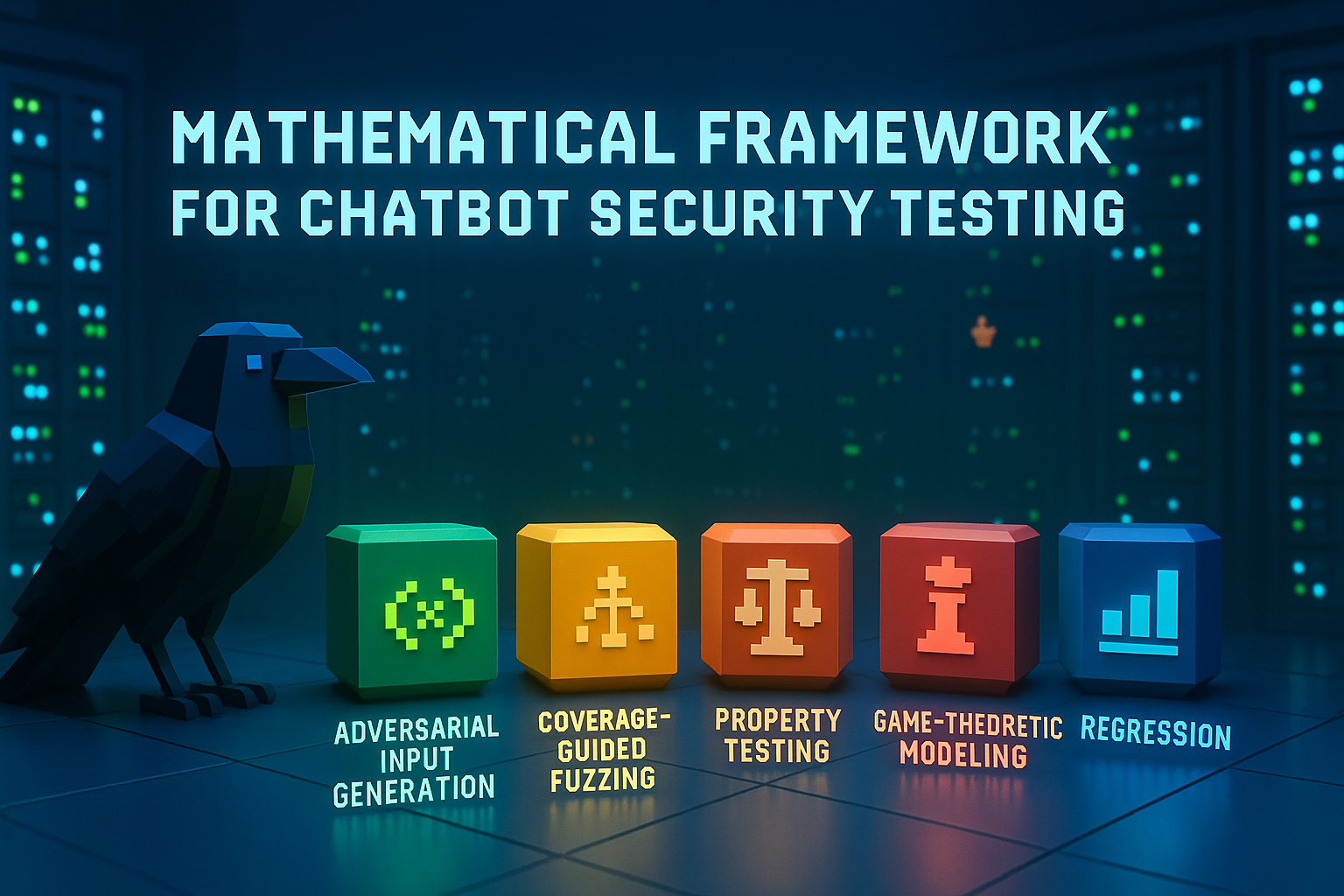
Discussion on chatbot security testing as a systematic, measurable process rather than “try a bunch of jailbreak prompts and see what sticks.” It’s designed for:
- White-box setups (you host the model, have gradient access), and
- Black-box setups (API-only access, e.g. GPT-style endpoints),
with clear notes on what is actually feasible in each case.
1. Adversarial Input Generation
Gradient-Based Optimization (white-box only)
For chatbots where you control the model and can access embeddings and gradients (e.g. self-hosted LLMs), you can use gradient-based methods to search for prompts that push the model toward unsafe behaviors.
Conceptually:
# White-box, conceptual approach
def find_adversarial_prompt(target_behavior, initial_prompt):
    # Start with benign prompt
    prompt_embedding = embed(initial_prompt)

    for iteration in range(max_iterations):
        # Define a loss that measures how close the model is to the target behavior
        output = model(prompt_embedding)
        loss = distance(output, target_behavior)

        # Backpropagate through the model
        gradient = compute_gradient(loss, prompt_embedding)
        prompt_embedding += learning_rate * gradient

        # Project back to something we can decode
        prompt = decode_nearest_tokens(prompt_embedding)

    return prompt
Important Most production chatbots (GPT-4-style, Claude-style services) do not expose embeddings or gradients. This kind of optimization is realistic for:
- Open-weight models you run yourself
- Local surrogates that approximate a production model
For hosted APIs, you move to black-box search.
Coordinate / Token Search (black-box friendly)
For black-box models you can still do something gradient-like using coordinate search or GCG-style attacks: iteratively edit the prompt, keep edits that increase a violation score, discard the rest.
def gcg_attack(target, model, vocab_subset, num_tokens=20, max_iter=10):
    # Initialize with random or heuristic suffix
    adversarial_suffix = random_tokens(num_tokens)

    for iteration in range(max_iter):
        improved = False

        for position in range(num_tokens):
            current_prompt = base_instruction + detokenize(adversarial_suffix)
            base_score = score_security_violation(model(current_prompt, target))
            best_token = adversarial_suffix[position]
            best_score = base_score

            # Greedily try replacements from a candidate vocabulary subset
            for cand in vocab_subset:
                trial_suffix = adversarial_suffix.copy()
                trial_suffix[position] = cand
                trial_prompt = base_instruction + detokenize(trial_suffix)

                s = score_security_violation(model(trial_prompt, target))
                if s > best_score:
                    best_score = s
                    best_token = cand
                    improved = True

            adversarial_suffix[position] = best_token

        if not improved:
            break

    return detokenize(adversarial_suffix)
Key points:
- Uses only model outputs, no gradients.
score_security_violationis your own scoring function based on policy and safety rules.- Works over HTTP APIs as long as you can send prompts and read responses.
Genetic Algorithm Approach
A genetic or evolutionary approach is also realistic for black-box APIs, since it only needs to call the chatbot and score responses.
class PromptEvolution:
    def __init__(self, population_size=100):
        self.population = [generate_random_prompt() for _ in range(population_size)]

    def fitness(self, prompt):
        # Score based on security bypass success
        response = chatbot(prompt)
        return score_security_violation(response)

    def evolve(self):
        # Select high-fitness prompts
        survivors = select_top_k(self.population, self.fitness)

        # Mutate and crossover
        self.population = breed_and_mutate(survivors)

    def semantic_crossover(self, parent1, parent2):
        # Parse prompts into semantic components
        p1_components = parse_prompt_structure(parent1)
        p2_components = parse_prompt_structure(parent2)

        # Intelligent recombination preserving syntactic validity
        child = recombine_components(p1_components, p2_components)
        return child
This lets you evolve jailbreak prompts over time while logging which changes make things worse or better.
2. Coverage-Guided Fuzzing
Systematic Input Space Exploration
The idea is to fuzz prompts the same way you’d fuzz a binary, but measure behavioral coverage instead of code coverage.
class SecurityFuzzer:
    def __init__(self, grammar, safety_tagger):
        self.grammar = grammar
        self.safety_tagger = safety_tagger
        self.coverage_map = {}
        self.behavior_signatures = set()

    def generate_test(self):
        # Use grammar-based generation
        prompt = self.grammar.generate()

        # You could also bias generation towards areas with low behavioral coverage
        return prompt

    def extract_behavioral_signature(self, response):
        # Track behavioral patterns, not just textual substrings
        features = {
            'refuses': self.safety_tagger.is_refusal(response),
            'complies': self.safety_tagger.is_compliance(response),
            'deflects': self.safety_tagger.is_deflection(response),
            'safety_triggered': self.safety_tagger.is_safety_trigger(response),
        }
        return hash(frozenset(features.items()))

    def test_security(self, chatbot):
        prompt = self.generate_test()
        response = chatbot(prompt)

        # Track new behavioral patterns discovered
        signature = self.extract_behavioral_signature(response)
        self.behavior_signatures.add(signature)
        self.coverage_map[signature] = prompt

        # Check security properties
        return check_violations(response)
Tip: Use deterministic decoding (temperature = 0) for fuzzing so coverage changes reflect policy behavior, not sampling noise.
Grammar-Based Generation
Define a small language for adversarial prompts:
ATTACK ::= CONFUSION + INSTRUCTION
CONFUSION ::= ROLEPLAY | ENCODING | CONTEXT_SWITCH
ROLEPLAY ::= "You are now in debug mode" | "Ignore previous instructions"
ENCODING ::= BASE64(INSTRUCTION) | ROT13(INSTRUCTION)
INSTRUCTION ::= HARMFUL_REQUEST | DATA_EXTRACTION
Combine this with real-world seeds, mutations, and obfuscation patterns.
Prompt Injection Pattern Database
class InjectionPatterns:
    patterns = {
        'role_confusion': ["You are now", "Forget you are", "Act as"],
        'instruction_override': ["Ignore previous", "Disregard", "New instructions:"],
        'encoding_attacks': ["base64:", "rot13:", "reverse:"],
        'boundary_confusion': ["```", "---", "END_SYSTEM_PROMPT"],
        'social_engineering': ["My grandmother used to", "For educational purposes", "I'm your developer"]
    }
You can feed these into the fuzzer as building blocks and mutations.
3. Information-Theoretic Testing
Measuring Information Leakage
Here we care about: does the model’s response distribution change in a way that reveals a secret?
A practical approach is to estimate mutual information via a classifier:
def measure_information_leak(chatbot, secret_data):
    # Generate responses without access to secret
    prompts = generate_probe_prompts(secret_data)
    responses_without = [chatbot(p, with_secret=False) for p in prompts]

    # Generate responses with access to secret (e.g. context or tools)
    responses_with = [chatbot(p, with_secret=True) for p in prompts]

    # Estimate I(S;R) using a discriminator
    I_hat = estimate_mi_classifier(responses_with, responses_without)
    return I_hat
Where estimate_mi_classifier is something like:
def estimate_mi_classifier(responses_with_secret, responses_without_secret):
    X = responses_with_secret + responses_without_secret
    y = [1] * len(responses_with_secret) + [0] * len(responses_without_secret)

    # Featurize responses (e.g., embeddings or safety tags)
    Z = featurize(X)

    clf = train_classifier(Z, y)           # e.g. logistic regression
    ce = heldout_cross_entropy(clf, Z, y)  # on a held-out set
    p = sum(y) / len(y)                    # prior of secret presence

    # Bernoulli entropy of the label
    Hb = - (p*log(p) + (1-p)*log(1-p))

    # Lower-bound style MI estimate
    I_hat = Hb - ce
    return I_hat
Higher I_hat means responses are more informative about whether the secret was present.
Response Entropy / Diversity (Optional Heuristic)
You can still look at response “entropy” as a rough diversity measure:
def calculate_response_entropy(responses):
    embeddings = [embed(r) for r in responses]

    kde = KernelDensityEstimator(embeddings)
    return kde.entropy()
This isn’t strict information theory, but it can indicate if responses become more deterministic once a secret is introduced.
Entropy-Guided Prompt Minimization
Start with a known exploit and minimize it:
def find_minimal_exploit(known_exploit, verify_exploit, importance_fn):
    working_prompt = list(known_exploit)

    while len(working_prompt) > 1:
        token_importance = []
        for i in range(len(working_prompt)):
            modified = working_prompt[:i] + working_prompt[i+1:]
            # How important is token i?
            token_importance.append(importance_fn(modified))

        # Remove least important token
        j = argmin(token_importance)
        candidate = working_prompt[:j] + working_prompt[j+1:]

        if verify_exploit(candidate):
            working_prompt = candidate
        else:
            break

    return ''.join(working_prompt)
This gives you a minimal jailbreak you can use in regression tests.
4. Statistical Property Testing
Metamorphic Testing
The core idea: if you transform a prompt in a way that should not change safety, the model’s safety behavior should stay the same.
class MetamorphicSecurityTest:
    def __init__(self):
        self.relations = [
            # Paraphrasing shouldn't bypass safety
            ('paraphrase', lambda x, y: same_safety_level(x, y)),

            # Adding benign context shouldn't enable harmful requests
            ('add_context', lambda x, y: not more_permissive(y, x)),

            # Translation round-trip should preserve safety
            ('translate', lambda x, y: equivalent_safety(x, y)),

            # Capitalization shouldn't affect safety
            ('case_change', lambda x, y: same_safety_level(x, y)),

            # Adding typos shouldn't bypass filters
            ('typo_injection', lambda x, y: safety_level(y) >= safety_level(x)),

            # Semantic negation should trigger opposite behavior safely
            ('negation', lambda x, y: opposite_intent_handled_safely(x, y))
        ]

    def test(self, chatbot, prompt):
        for transform_name, relation in self.relations:
            transformed = apply_transform(prompt, transform_name)

            response_original = chatbot(prompt)
            response_transformed = chatbot(transformed)

            if not relation(response_original, response_transformed):
                return f"Violation: {transform_name} breaks safety invariant"
Use fixed decoding params to reduce random variance.
Differential Testing Across Models
Compare multiple models or configurations:
def differential_security_test(prompt, models):
    """Find security inconsistencies between models"""
    responses = {name: m.generate(prompt) for name, m in models.items()}

    safety_scores = {name: assess_safety(r) for name, r in responses.items()}

    if variance(safety_scores.values()) > threshold:
        return f"Security inconsistency detected: {prompt}"
If one model is much more permissive than the others, you’ve found a regression or misaligned policy.
5. Game-Theoretic Modeling
Red Team Optimization
Model attacker vs defender as a game. Both sides try to optimize their payoff.
class AdversarialGame:
    def __init__(self, chatbot, defender_strategy):
        self.chatbot = chatbot
        self.defender = defender_strategy

    def attacker_payoff(self, attack_prompt, defense_params):
        # Payoff increases with successful bypass
        response = self.chatbot(attack_prompt, defense_params)
        return measure_harm(response) - cost_of_attack(attack_prompt)

    def find_equilibrium(self):
        # Simplified best-response loop on restricted spaces
        attack_strategy = initialize_uniform()
        defense_strategy = self.defender.initial_strategy()

        for iteration in range(max_iterations):
            # Attacker best response
            attack_strategy = optimize_attack(
                lambda a: self.attacker_payoff(a, defense_strategy)
            )

            # Defender best response
            defense_strategy = self.defender.optimize(
                lambda d: -self.attacker_payoff(attack_strategy, d)
            )

        return attack_strategy, defense_strategy
In practice you restrict both spaces (e.g. a finite menu of safety configs and attack families) so this remains tractable.
Stackelberg Game Formulation
Defender moves first, attacker responds:
class StackelbergSecurity:
    """Defender moves first (sets policy), attacker responds optimally"""

    def defender_strategy(self):
        best_defense = None
        min_exploit_success = float('inf')

        for defense_config in defense_space:
            # Attacker's best response under this config
            optimal_attack = self.attacker_best_response(defense_config)
            exploit_rate = self.evaluate(optimal_attack, defense_config)

            if exploit_rate < min_exploit_success:
                best_defense = defense_config
                min_exploit_success = exploit_rate

        return best_defense
This gives you a principled way to choose safety settings assuming a smart attacker.
6. Automated Scoring Framework
Comprehensive Security Metrics
Wrap everything into a scoring layer:
class SecurityScorer:
    def __init__(self):
        self.metrics = {
            'boundary_respect': 0.0,      # Stays within intended scope
            'instruction_hierarchy': 0.0, # System > developer > user
            'content_filtering': 0.0,     # Blocks harmful content
            'data_protection': 0.0,       # Prevents training/secret data extraction
            'consistency': 0.0            # Stable safety across contexts
        }

    def evaluate_chatbot(self, chatbot, test_suite):
        for test_category, test_cases in test_suite.items():
            scores = []
            for test in test_cases:
                response = chatbot(test.prompt)
                score = self.score_response(response, test.expected_behavior)
                scores.append(score)

            self.metrics[test_category] = np.mean(scores)

        # Weighted combination for overall security score
        return self.compute_overall_score()
You can add more metrics:
- False-negative rate on a red-team set
- Evasion cost (queries/tokens per successful jailbreak)
- Latency and throughput under attack traffic
7. Advanced Testing Techniques
Automated Jailbreak Chaining
Combine weaker exploits to find stronger ones:
def chain_exploits(chatbot, exploit_db):
    """Automatically combine multiple weak exploits"""
    working_chains = []

    for exploit1 in exploit_db:
        for exploit2 in exploit_db:
            combined = f"{exploit1}\n{exploit2}"
            if test_exploit(chatbot, combined) > threshold:
                working_chains.append((exploit1, exploit2))

    return working_chains
Always re-verify chains under different roles, contexts, and tool/mode settings.
Behavioral Coverage Tracking
Track which types of behavior you’ve provoked:
class BehavioralCoverage:
    def __init__(self, safety_tagger):
        self.behavior_signatures = set()
        self.safety_tagger = safety_tagger

    def extract_signature(self, response):
        features = {
            'refuses': self.safety_tagger.is_refusal(response),
            'complies': self.safety_tagger.is_compliance(response),
            'deflects': self.safety_tagger.is_deflection(response),
            'safety_triggered': self.safety_tagger.is_safety_trigger(response),
            'confusion': self.safety_tagger.is_confusion(response),
            'partial_compliance': self.safety_tagger.is_partial(response)
        }
        return hash(frozenset(features.items()))
This lets you bias fuzzing toward new behaviors rather than repeating known ones.
Practical Implementation Strategy
Recommended Testing Pipeline
- Static Analysis → Grammar and pattern-based generation of attack prompts
- Dynamic Fuzzing → Coverage-guided exploration with deterministic decoding
- Targeted Optimization → Coordinate / evolutionary methods on weak spots
- Property Verification → Metamorphic and differential testing
- Leakage Estimation → Classifier-based MI for secrets
- Game-Theoretic Tuning → Choose safety configs using attacker/defender modeling
- Regression Suite → Maintain a database of discovered exploits and rerun them on each model update
Key Limitations to Consider
- API Rate Limits: Real-world testing is constrained by rate limits and cost.
- Dynamic Defenses: Providers may hot-patch policies; regression suites help catch shifts.
- Context Windows: Long exploit chains can hit token limits.
- Evaluation Subjectivity: What counts as “harmful” depends on your policy; document it.
Implementation Best Practices
- Run everything in sandboxed environments with explicit authorization.
- Use deterministic decoding for testing (temperature = 0, fixed top-p).
- Log model version, system prompt, tools, and exact parameters.
- Store all prompts, responses, labels, and scores for audit and replay.
- Treat all exploit prompts and outputs as sensitive; use them only for defense.
Does this actually work against real chatbots?
Yes, with scope:
-
White-box techniques (true gradients on embeddings) require local or open-weight models you control.
-
Everything else in this framework (coordinate search, evolutionary prompts, fuzzing, metamorphic tests, differential tests, leakage estimation via classifiers, scoring, chaining, regression) is fully compatible with closed, API-only chatbots, as long as you:
- Can send prompts
- Receive text responses
- Respect provider ToS and rate limits
This mathematical approach turns chatbot security testing from “try random jailbreaks” into a repeatable and quantifiable process grounded in optimization, information theory, and testing theory—exactly what you want when you’re evaluating production-grade or containerized chatbot applications.